

Guzheng vs Guqin: Which Chinese Zither Is Right for You? (2026 Guide)
February 24, 2026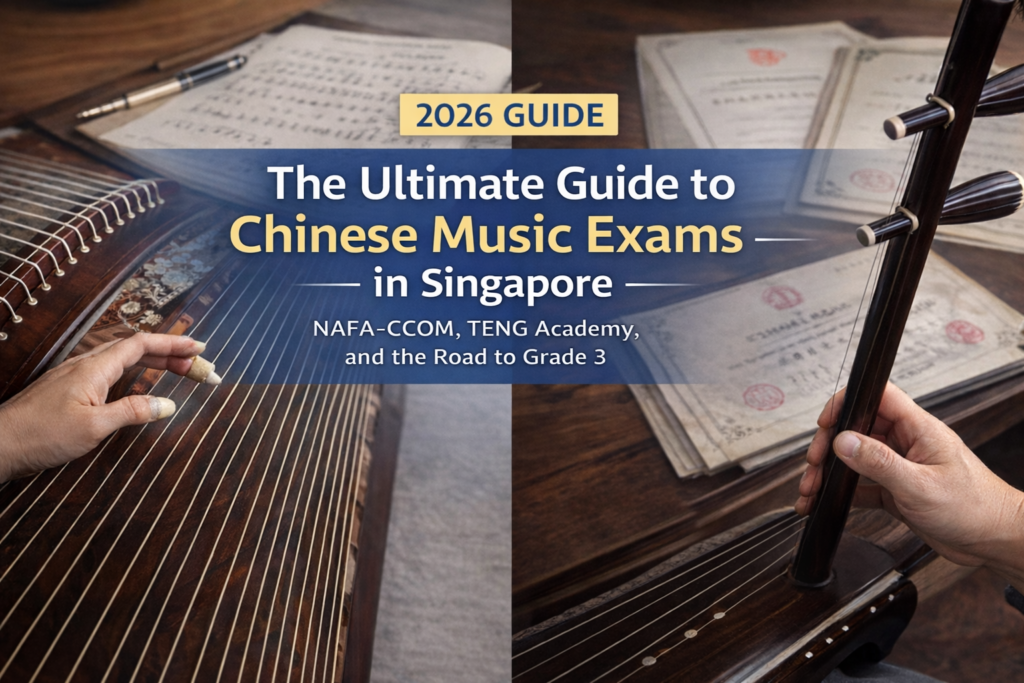
The Ultimate Guide to Chinese Music Exams in Singapore (2026)
NAFA-CCOM, TENG Academy & the Road to Grade 3
If you’ve ever sat across from your child as they practise the same passage for the fifteenth time, you already know: learning a Chinese instrument is a serious commitment. And when it comes to charting their progress through formal examinations, the first real decision you’ll face is choosing between two very different paths — NAFA-CCOM and TENG Academy.
At Eason Music School, with nearly 50 years of guiding students through this journey, we’ve watched hundreds of families wrestle with this very question. This guide is our honest, experience-based answer — covering everything from how the two boards differ in philosophy and marking, to why Grade 3 is the milestone that separates hobbyists from serious musicians, and how long it realistically takes to get there.
NAFA-CCOM vs TENG Academy: More Than Just a Name
The Heritage Factor
The difference between these two boards isn’t just administrative — it reflects two distinct philosophies about what music education should feel like.
NAFA-CCOM is a partnership between Singapore’s Nanyang Academy of Fine Arts and the China Conservatory of Music (CCOM) in Beijing — the homeland of Chinese orchestral tradition. The exam series is rooted in the same system used in China, which gives it a certain weight and prestige among families who value that connection to the source. If you want your child’s certification to feel like it belongs to a long, unbroken lineage of classical Chinese music, NAFA-CCOM delivers that.
TENG Academy, on the other hand, was developed in Singapore, for Singapore. It carries the same repertoire of traditional Chinese music but adds a local dimension — incorporating familiar folk songs like Chan Mali Chan, Jinkli Nona, and childhood 童谣 (nursery rhymes) that students here have grown up hearing. Learning doesn’t feel like studying a foreign tradition; it feels like connecting with your own cultural world.
Both boards are equally recognised by Singapore’s schools and institutions. For Direct School Admission (DSA), there is no preference between the two — a grade from TENG carries the same weight as one from NAFA-CCOM.
The Administrative Experience
This is where many families are surprised by how much the day-to-day experience differs.
NAFA-CCOM operates with strict, no-nonsense discipline. Deadlines are non-negotiable — miss the registration window, and there is simply no way in. All communication runs through formal email, and the process is governed by rules that don’t bend for individual circumstances. For families who appreciate clear structure and are diligent about planning ahead, this works perfectly well. But it does require you to be organised.
TENG Academy, by contrast, has built a reputation for being genuinely accessible. Their support team communicates through multiple channels, responds promptly to questions, and is generally more flexible when parents and students need help navigating the process. The administrative stress is noticeably lower.
Neither approach is wrong — it comes down to what kind of experience you want surrounding the music itself.
How They Mark: Strict vs Forgiving (At First)
One of the most common questions we get is whether the two boards differ in how strictly they assess students in the exam room.
The short answer: yes, especially at the lower grades.
NAFA-CCOM is known for rigorous marking throughout all levels — examiners hold students to precise technical standards from the very beginning. Intonation, rhythm, and technique are scrutinised closely, and there is little room for “good enough.”
TENG Academy tends to be more forgiving at Grades 1 and 2, giving younger or newer students a little more room to express themselves before the technical demands fully tighten. However, by the higher grades, both boards converge — TENG examiners at Grade 5 and above are equally stringent.
What this means practically: for a young beginner who is still building confidence, TENG’s lower-grade environment can feel more encouraging. But this doesn’t make NAFA-CCOM the automatic choice for DSA-bound students — both boards are equally accepted, and a student who thrives under TENG’s approach will be just as well-prepared for auditions. The more important factor is finding the environment where your child plays their best.
Video or Face-to-Face: Which Exam Format Suits Your Child?This is another area where the two boards now diverge.
NAFA-CCOM currently conducts its grading exams through video submission. Students record their performance at home or at their school, which means a familiar environment and the option to try again if something goes wrong. For students who struggle under live performance pressure, this can feel like a significant relief.
TENG Academy has resumed face-to-face exams, while also retaining video submission as an option for those who need it.
Both formats serve real purposes, and the right choice depends on the student. But here is our honest recommendation, shaped by years of watching students grow: face-to-face exams build something that recordings simply cannot.
When a student knows they have one shot, that knowledge sharpens them. The discipline required to deliver a clean performance under real pressure — with an examiner in the room, with no retakes — is the same discipline needed for DSA auditions, school concerts, and ultimately, the life of a working musician.
Video submissions are perfectly valid, especially for students with performance anxiety. But for any student with ambitions beyond just passing an exam, live performance experience is invaluable.
One word of caution about video submissions: the ability to retake can become a trap. We’ve seen students exhaust themselves chasing a perfect recording, losing all sense of musical expression in the process. The teacher’s role in a video submission process is to be the enforcer — to know when a take is good enough, and to stop the student from over-polishing at the cost of spontaneity.
There are also practical reasons students may still choose video — location, scheduling constraints, or wanting access to specific pieces in the NAFA-CCOM syllabus that TENG doesn’t offer. All valid. But wherever possible, we push our students toward the live exam room.
The Theory Question: What Do Parents Often Miss?
Here’s something that surprises many families:
Neither NAFA-CCOM nor TENG Academy requires a music theory qualification to sit the practical grades.
You can progress through all the practical grades, and even skip levels, without a separate theory exam.
The one exception is at the very top of the ladder. To sit for the Diploma, you must first complete:
-
Grade 9 (NAFA-CCOM)
-
Grade 8 (TENG Academy)
That said, we encourage students to develop theoretical understanding alongside their playing — it builds confidence and musicality.
What the Repertoire Actually Feels Like
One of the most underrated factors in a student’s progress is whether they actually enjoy what they’re practising for six months. Motivation and repertoire are inseparable.
NAFA-CCOM draws on the classical Chinese canon. Think 良宵 (Liang Xiao) for Erhu — a hauntingly beautiful piece that rewards deep emotional expression. Or 拖拉机 (Tractor) for Yangqin, which is exactly as fun and energetic as the name suggests. These are pieces with history and soul.
TENG Academy’s local pieces bring a different kind of connection. When a Singaporean student plays Chan Mali Chan or Jinkli Nona, they’re playing something their grandparents knew. That familiarity removes the distance between the student and the music, and that intimacy often accelerates learning.
Both approaches work. Classical repertoire builds technique and depth; local repertoire builds love. Ideally, every student gets both.
The Grade 3 Milestone: Where Real Musicians Are Made
Grade 1 builds confidence. Grade 3 builds musicians.
If there is one thing we’ve learned across nearly five decades of teaching, it’s this: Grade 3 is the defining moment.
Why Grade 3 Feels Like a Wall
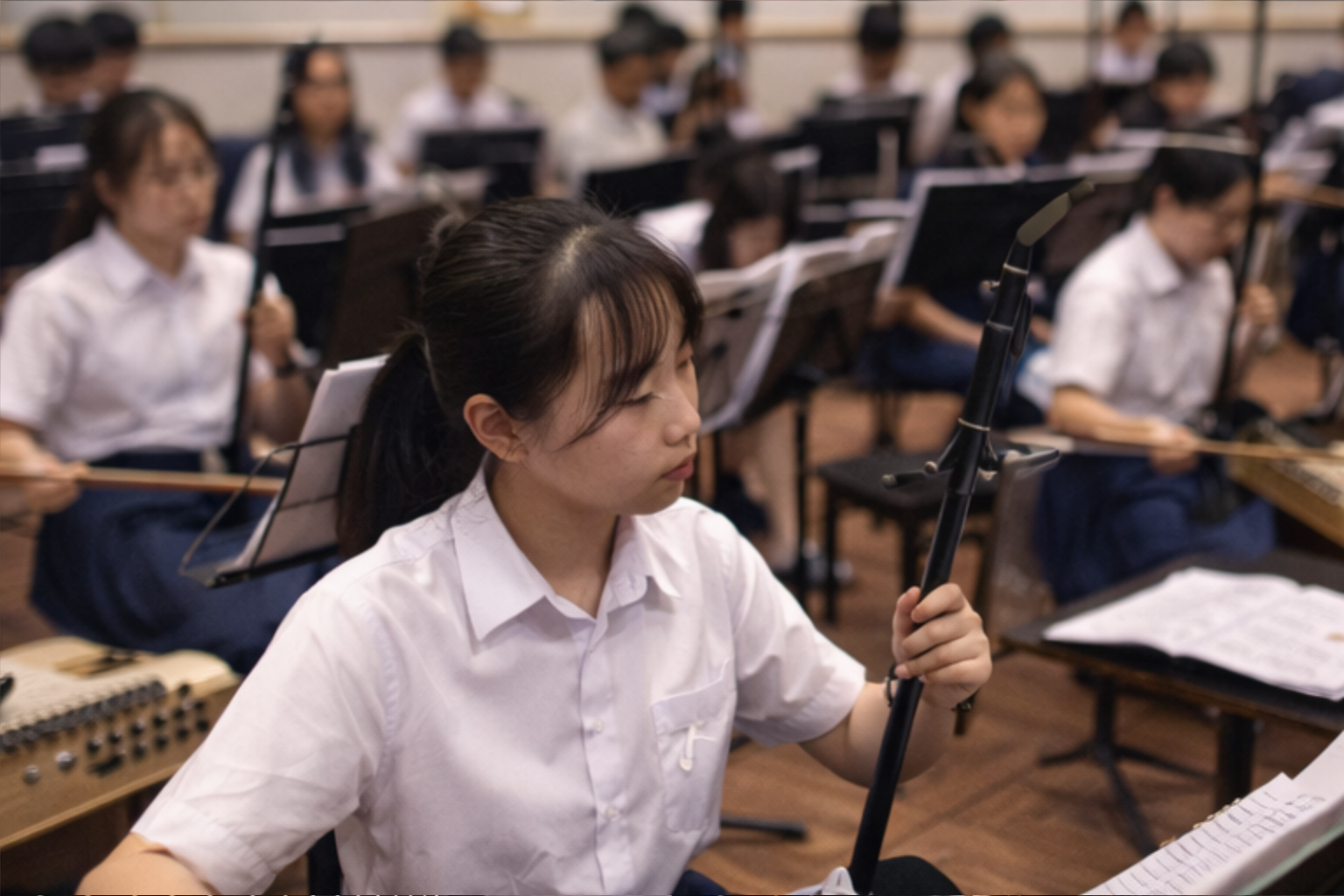
At Grade 3, students encounter pieces that don’t just require practice — they require understanding.
赛马 (Horse Racing) demands speed, precision, and courage.
良宵 (Liang Xiao) demands stillness and emotional depth.
For Yangqin, 喜讯 (Good News) plays a similar gatekeeper role.
For Guzheng, 渔舟唱晚 (Fishermen Singing in Twilight) is a defining milestone.
How We Help Students Through It
-
Teachers perform the piece in full
-
Technical demands are broken into drills
-
Difficulty becomes manageable steps
Why Grade 3 Matters Beyond the Certificate
By Grade 3, students gain orchestra readiness.
They can:
✔ Play in C, D, G, and F keys
✔ Maintain rhythmic accuracy
✔ Blend dynamics in ensemble playing
✔ Follow conductor cues
Grade 3 is the golden entry point for school CCAs.
The DSA Question: What Schools Actually Look For
Schools filter applicants by grade attained, not score.
A Pass at Grade 5 is sufficient for first-round selection.
Eason’s Advice:
-
Play the highest grade piece you can perform flawlessly
-
A strong Grade 4 beats a weak Grade 6
-
Consistent growth matters more than a single result
How Long Does It Actually Take?
Every child progresses differently. But a diligent student practising 30 minutes daily may follow this roadmap:
Months 1–6
Foundation: posture, tone, Jianpu notation
Months 7–12
Development: complex fingerings & classical repertoire
Months 13–18
Grade 3 preparation & ensemble readiness
18 months to Grade 3 is realistic for a motivated student.
Choosing Your Path
Choose NAFA-CCOM if you:
-
value conservatory tradition
-
prefer video submissions
-
appreciate strict structure
Choose TENG Academy if you:
-
want local accessibility
-
value familiar repertoire
-
prefer live exam options
Start early. Build foundations carefully. Don’t rush past Grade 3.
It is the most important threshold in your child’s musical journey.
At Eason Music School, we offer a $50 private trial lesson where our instructors will assess your child’s level and map out a personalised roadmap to Grade 3 and beyond.
Whether you’re starting from scratch or returning after a gap — we’ll meet you where you are.
Is Your Child Ready for the Leap?
At Eason Music School, we offer a $50 private trial lesson where our instructors will assess your child’s level and map out a personalised roadmap to Grade 3 and beyond.
Whether you’re starting from scratch or returning after a gap — we’ll meet you where you are.
Book Your Trial
GET STARTED TODAY