

The Art of Erhu Craftsmanship: Inside the World of Master Yu Kai Ming
November 13, 2025
Erhu: A Closer Look at Master Maker Hu Han Rou (胡函柔)
January 19, 2026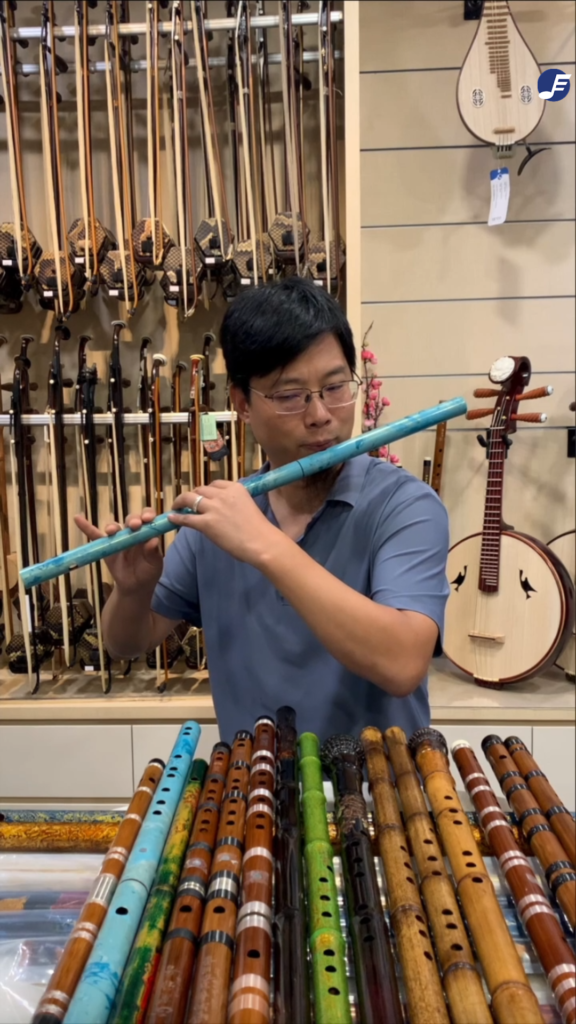
Guo Xinming (郭新明): Precision, Lacquer Craft, and the Modern Voice of Dizi & Xiao
Some instrument makers talk about bamboo. Others talk about tradition. Guo Xinming (郭新明) speaks about something deeper: how a Dizi or Xiao must behave in the real world—under breath, under temperature changes, inside ensemble tuning, and across years of playing.
When Guo visited in person, we recorded a series of videos where he introduced his background, explained how he approaches modern performance needs, and demonstrated several instruments—Dizi and Xiao—while also sharing practical care and maintenance advice. What emerged was a coherent philosophy: sound, stability, and responsiveness are not “features”—they are outcomes of disciplined craft.
Who Is Guo Xinming (郭新明)?
Guo Xinming is from Hangzhou and has been professionally making pan flutes, Dizi, and Xiao for about 15 years. His training and influences are rooted in major conservatory traditions:
-
He studied Dizi under Professor Zhan Yongming (Shanghai Conservatory of Music).
-
He learned pan flute from Master Lin Wenzeng.
-
His Xiao approach was influenced by renowned Dizi/Xiao performer Professor Chen Yue (China Conservatory of Music).
This background matters because his making priorities come from a performer’s reality: intonation accuracy, pitch stability, response, and clarity.
Guo Xinming (郭新明) — Hangzhou-based maker of Dizi, Xiao, and pan flutes.
A Workshop Focused on Mid‑ to High‑End Instruments
Guo describes his workshop as focusing mainly on mid‑ to high‑end products, with an emphasis on:
-
Rich resonance
-
Accurate intonation
-
Better pitch stability
-
Sensitivity and clarity
A key point he makes is that modern musicians increasingly need instruments that hold up in demanding contexts—large ensembles, pianos, orchestras, and recording environments—where tuning must be precise and blend must be reliable.
Browse Guo Xinming’s Dizi listings here:
https://www.easonmusicstore.com/collections/dizi-instrument/guo-xinming
Tuning Philosophy: Traditional Skill + Modern End hybrid Methods
Guo repeatedly returns to tuning as the core of performance quality. His method combines:
-
Traditional hole-carving tuning
-
Modern endoscopic tuning techniques
He explains that traditional methods alone often can’t meet today’s standards for tonal tension, tuning accuracy, and ensemble compatibility. His work aims to support players who need expressive flexibility and dependable tuning.
Guo also shares that he personally focuses on this “core tuning process,” spending 8–10 hours daily refining:
-
Intonation
-
Tone quality
-
Resonance
Overall performance balance
Bamboo Selection: Materials Chosen for Specific Acoustic Goals
Dizi Bamboo
For Dizi, Guo primarily uses ku bamboo from Hangzhou, specifically near Tongling Bridge, citing its favorable balance of:
-
Density
-
Natural taper (gradual narrowing from mouthpiece to end)
-
Proportions well-suited to Dizi acoustics
For lower-pitched Dizis, he may select ku bamboo from Jiangxi or nearby regions, describing it as heavier and denser, better suited for low keys.
He also mentions purple bamboo and spotted bamboo as occasional choices, but notes that 80–90% of performers still prefer Hangzhou ku bamboo for Dizi.
Xiao Bamboo
For Xiao, his material choices shift:
-
Dongxiao & Qinxiao: mostly purple bamboo from Anhui or Jiangxi, producing a smoother, more mellow tone with consistent inner diameter that supports accurate intonation and resonance.
-
Nanxiao (southern xiao): almost exclusively Taiwanese gui bamboo, with occasional use of gui bamboo from Fujian.
He emphasizes that bamboo alone is only part of the story: the inner bore finishing and polishing technique is crucial.
Why Every Step Matters (and Why Tuning Is Still the Final Gate)
Asked about the most difficult part of Dizi making, Guo doesn’t isolate one step—he argues that a good Dizi requires excellence at every stage:
-
Even roasting (to avoid irregular inner bore)
-
Hole placement and hole shape (years of accumulated experience)
-
Lacquer technique
-
String binding
-
Copper joint fitting (where applicable)
And then: tuning—what he calls the most crucial step.
Daqi (大漆) Lacquer Craft: Stability, Durability, and Visual Uniqueness
One of the defining characteristics of Guo’s instruments is the use of natural lacquer (daqi / raw lacquer) applied and polished in layers.
He describes:
-
Around 10 layers for certain finishes
-
Around 40 layers for colored versions (sometimes more)
Done properly, he says, this results in:
-
Stable performance
-
Durability (not easily peeling)
-
Crack resistance
-
A stronger “sound texture”
-
A visually unique finish where no two instruments look exactly the same
He notes the lacquer approach has been applied to Dizi and Xiao for over ten years, and the process is mature—supported by long-term exchange with performers.
The Daqi Series: Professional‑Level Dizi With Dynamic Control
Guo describes a more professional model with greater dynamic variation and mentions that his earlier demo included a top-tier model (in D key). He also describes the Daqi (大漆) series as being made from carefully selected bamboo, with a feeling of substance and refinement.
He characterizes its playing qualities as:
-
Extremely responsive
-
Focused and powerful
-
Full, solid tone
Keys and Lacquer Color Palettes
He states the series covers almost all common keys, including:
-
Big G, A, B-flat, C, D, E, F, G, small A
and also special requests such as: -
C#, F#, Eb
Color palettes include:
-
Black series
-
Red series
-
Blue series
-
Green series
Explore Guo Xinming’s Dizi lineup (including lacquer-finished models) here:
https://www.easonmusicstore.com/collections/dizi-instrument/guo-xinming
Xiao: Modern Expressiveness Built on Traditional Foundations
Guo explains two main types of dongxiao:
-
Closed-end: easier for beginners
-
Open-end: greater expressive potential, dynamic range, and resonance
He notes the difference in playing feel is slight and that both can be balanced and well-made. From a maker’s perspective, the open-top positioning can make crafting smoother, supporting precision.
Dynamic Range as a Design Goal
Guo defines “dynamic control” as an instrument’s ability to be expressive, describing a range from:
-
ppp (extremely soft) to fff (powerfully loud)
He contrasts this with traditional Xiao designs that may not respond even with increased air. His modern-style Xiao incorporates acoustic elements—drawing inspiration from techniques used in flutes and shakuhachi, combined with traditional Xiao-making methods.
Northern and Southern Xiao
He demonstrates both:
-
Dongxiao (including lacquer-finished models)
-
Southern Xiao (Nanxiao) made from Taiwanese gui bamboo, described as having larger volume and stronger projection, with even greater dynamic control.
Browse Guo Xinming’s Xiao listings here:
https://www.easonmusicstore.com/collections/xiao-instrument/guo-xinming
Professional Use and Long-Term Collaboration
Asked whether professional performers use his instruments, Guo answers emphatically that many do, naming organizations and institutions including:
-
China Conservatory of Music
-
Shanghai Conservatory of Music
-
Sichuan Conservatory of Music
-
Xinghai Conservatory of Music
-
China National Opera & Dance Drama Theater
-
Oriental Song and Dance Troupe
-
China National Traditional Orchestra
He also says his instruments have appeared at major events such as the Spring Festival Gala, Lantern Festival Gala, and even state-visit contexts.
He further confirms a ten-year collaboration with Professor Chen Yue, stating that Chen Yue uses his flutes and Xiao.
Maintenance & Care: Practical Advice From the Maker
Guo divides daily care into two categories:
Dizis Without Metal Joints
-
Avoid high temperatures and direct sunlight
-
Avoid excessive humidity (risk of mold)
-
After playing: do not store in a sealed bag; avoid airtight storage
-
Let the instrument air out naturally
He specifically notes that in Singapore, humidity is high—so airflow and drying habits matter.
Dizis With Metal Joints
-
Apply petrolatum regularly to prevent rust and keep joints lubricated
-
Avoid heat, direct sun, excessive humidity
-
After playing: standing the Dizi upright is recommended
-
Avoid knocks and drops
Lifespan
Guo states:
-
Traditional Dizis may last 10–20 years
-
Lacquer-coated Dizis can last 100 years or more, because the lacquer layers isolate bamboo from air
When Tone Deteriorates
-
If soaked or too humid: vibration is affected
-
If too dry (more relevant in Northern China than Singapore): tone can become dry and dull
He emphasizes balance: too wet is bad, too dry is also bad.
Interior Finishing: Why Dizi and Xiao Are Treated Differently
Guo explains an important technical distinction:
-
For Dizi, the outside uses lacquer, but inside he uses shellac.
He says lacquer inside is too hard and can make the sound overly rigid—especially because Dizi uses dimo, which is extremely sensitive. If the interior becomes too hard, delicate soft passages may not respond well, and the tone can become harsh. -
For Xiao, since it does not use dimo, he uses lacquer inside, which improves stability in intonation and overall performance.
This is the kind of detail serious players appreciate: it’s not “one coating fits all,” but design decisions tied directly to how the instrument produces tone.
On “Seasoning” a Dizi: His Clear Position
Guo does not subscribe to the belief that a Dizi must be “played in” to become good. He states that:
-
A good Dizi is already good
-
It should play well immediately and bring joy from day one
-
His process aims for instruments to be sold only in an optimal state
Advice for Beginners: Start With an Instrument That Helps You Stay
Guo’s advice is direct: beginners shouldn’t start with poor-quality Dizis. If the tuning is bad or the instrument is hard to play, beginners lose interest quickly.
A well-made instrument, he says:
-
Feels comfortable
-
Sounds pleasant
-
Encourages practice
-
Builds attachment and care
-
Supports long-term growth
Closing Reflection: Why Makers Like Guo Xinming Matter
Guo Xinming’s visit and demonstrations show a modern maker grounded in tradition but unafraid of technical clarity. His priorities—accurate intonation, stable performance, dynamic expressiveness, and thoughtful finishing—speak to what today’s Dizi and Xiao players actually need, whether they perform solo, in ensemble, or in recorded settings.
For anyone seeking a high-end dizi, a professional dizi maker, a refined Chinese bamboo flute, or a responsive handcrafted xiao within the living world of traditional Chinese wind instruments, Guo’s words—and his sound—make a compelling case for craft that is both disciplined and musical.
Dizi collection:
https://www.easonmusicstore.com/collections/dizi-instrument/guo-xinming
Xiao collection:
https://www.easonmusicstore.com/collections/xiao-instrument/guo-xinming