
Chinese Instruments in an HDB: Quiet Practice Tips for Apartment Musicians in Singapore
March 19, 2026
The Rare Instrument Strategy: Your Secret Edge for DSA 2026 | Eason Music
April 10, 2026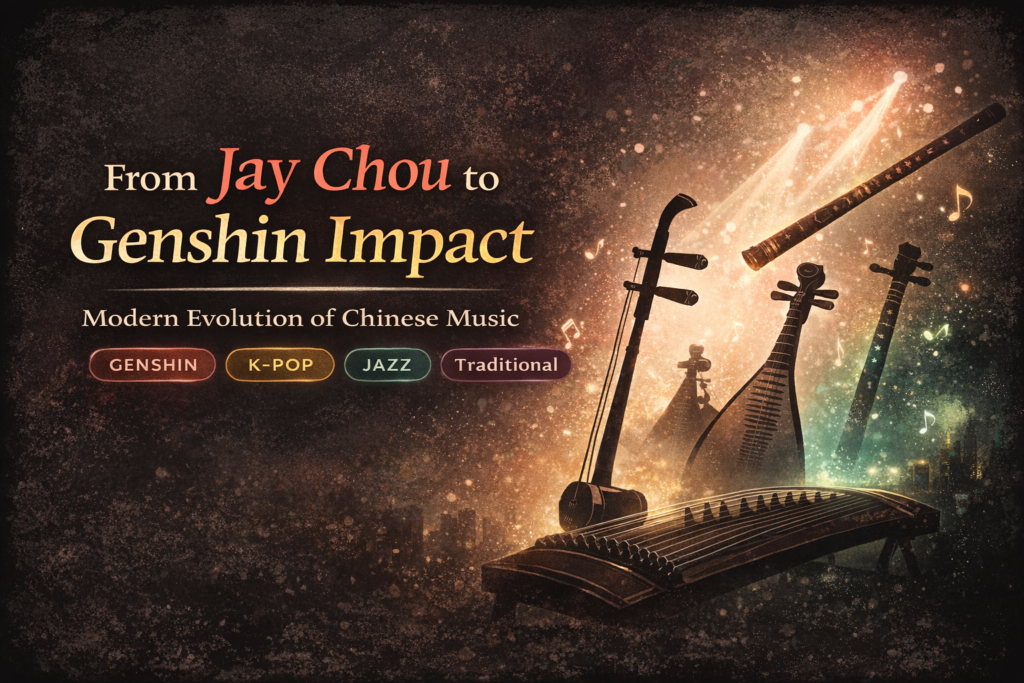
From Jay Chou to
Genshin Impact:
The Modern Evolution
of Chinese Music
Chinese instruments have left the teahouse. From gaming soundtracks to K-Pop covers, the Erhu, Pipa, and Guzheng are the ultimate chameleons of modern music.
Gaming, K-Pop & the New Generation of Players
Modern students arrive with a specific "must-play" list in hand. The instruments haven't changed — but the music driving people to pick them up certainly has.
The Liyue region soundtrack — with its sweeping Guzheng melodies and breathy Dizi lines — has inspired an entire generation to seek out these instruments. "I want to sound like that" is one of the most common things we hear from new students under 25.
Songs like Golden by Jungkook and tracks from Demon Hunter (K-Pop) are being reimagined on Erhu and Pipa with striking results. The emotional range of bowed strings suits these vocal-driven melodies perfectly.
The game's cinematic Chinese orchestral score has brought a whole new audience to traditional instruments — particularly the Erhu and percussion. It sounds ancient; it feels completely fresh.
We don't force you into traditional scales from day one. For melody-driven instruments like the Dizi and Erhu, we provide Jianpu (numbered notation) for pop hits you already love. We often use backing tracks so you feel like you're performing the studio version — right in your first lesson.
Turning the Pipa into a Drum Kit
How do you play a high-energy K-Pop beat on a traditional stringed instrument? You get creative with the anatomy of the instrument itself.
Our teachers show you how to "choke" the strings to create a sharp, percussive "clack" — the kind of tight rhythmic hit you hear in modern pop production. The Pipa becomes a rhythm machine.
To mimic a drum kick or snare, students are taught to knock on the soundboard of the Pipa or Zhongruan. This turns the instrument into a hybrid string-percussion tool — perfect for rhythmic modern tracks where a lone melody line won't cut it.
The most common feedback we get after a performance is: "I didn't know Chinese instruments could sound so modern!"
— Audience reaction after EM Pop Trio performanceThe Zhongruan's Secret Identity
If you love Jazz or Bossa Nova, the Zhongruan might be the most underrated instrument in the entire Chinese orchestra.
Its circular body, fretted neck, and warm midrange tone make it a natural fit for Western harmonies. Play a 1-4-2-5 chord progression with a syncopated Bossa Nova rhythm and it transforms instantly. When we finger-pick the chord progression of Manhã de Carnaval on a Zhongruan, the tone sits somewhere hauntingly between a classical guitar and a lute — and every time, someone in the room looks up.
This proves the central point: these instruments aren't tools for "Chinese sounds." They are tools for all sounds. The limitation was never the instrument — it was our imagination of what it could do.
Our Own "Aha!" Moment: The EM Pop Trio
Eason Music's own ensemble is a living demonstration of this shift. Each instrument brings something unexpected to the modern sound.
Plays the role of the vocalist. Its ability to mimic the emotional "soul" of a human voice makes it perfect for the soaring lines of a power ballad — it can sigh, wail, and whisper in a way no guitar can.
View Instruments →The hammered dulcimer can sound like a Baroque harpsichord one moment and a modern "indie" piano the next. Its bright, percussive attack cuts through any mix and gives the trio a rhythmic backbone.
View Instruments →Handles both rhythm (through muted strums and body knocking) and melody — often simultaneously. The "guitar" of the ensemble, and the most immediately relatable to audiences new to Chinese music.
View Instruments →Music Should Sound Like What You Love
We believe the best practice is the practice you actually do. Here's what we've seen happen when students learn the music they already care about:
It's far easier to pick up your instrument when you're working on a song already on your Spotify playlist. Motivation stops being a problem.
Adapting a K-Pop beat or a Jazz chord progression requires genuine musicianship. Students who learn modern styles often become more well-rounded players than those who stick exclusively to traditional repertoire.
Playing a Jay Chou melody or a Black Myth: Wukong theme on a Guzheng or Erhu at a gathering is a guaranteed way to stop the room. It bridges generations and cultures in a single phrase.
Ready to Play Your Favourite Soundtrack?
Whether you want to master Bossa Nova on the Zhongruan or the sweeping themes of Genshin on the Dizi — our instructors are ready.
Tell us your favourite modern song. We'll show you how to make it sound amazing on a Chinese instrument.
Book a $50 Trial Lesson · Bring Your Request