


The Rare Instrument Strategy: Your Secret Edge for DSA 2026 | Eason Music
April 10, 2026The Guzheng Buyer’s Guide: Everything You Need to Know Before You Buy
May 29, 2026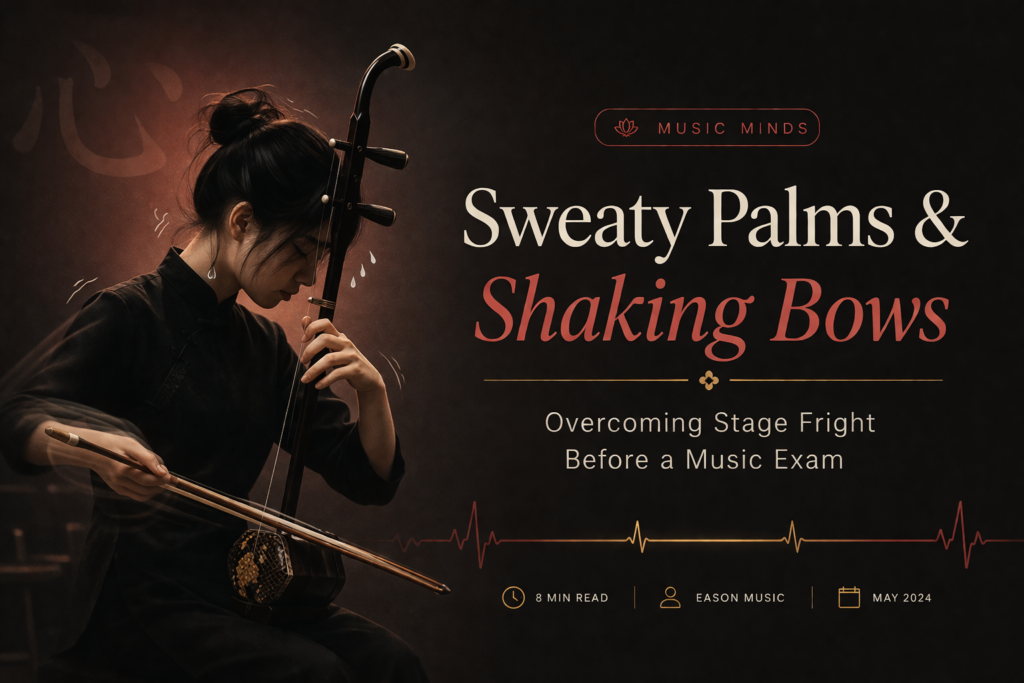
Sweaty Palms &
Shaking Bows:
How to Overcome Stage Fright
Before a Music Exam
You've practiced for months. You know every note. So why does your heart start pounding the moment you step outside the examination room?
It's a scene every music student knows: you've practiced for months, you know every note of your Pipa or Erhu piece, but the moment you stand outside the examination room, your heart starts pounding and your fingers feel like ice.
— Every music student, everIn Singapore, where music exams and competitions are significant milestones, stage fright is often the biggest hurdle to a Distinction. At Eason Music, we believe an exam shouldn't just be about surviving — it should be about performing. Here is our expert guide to turning those nerves into your greatest asset.
The "Only One Chance" Ritual
You wouldn't sit your PSLE without doing a practice paper. So why take a music exam without a proper "pressure test"?
Many of our instructors run formal Mock Exams for students preparing for high-level grades and competitions. We simulate the high-pressure environment — the student must perform for a "judge" (often a different teacher they haven't played for before).
A real exam gives you no second take. The mock exam trains your brain to treat every run-through as the real thing — so when the real thing arrives, it feels like a familiar routine.
Mock exams build mental stamina. The goal is that your highest-level performance — not a nervous, rushed version — becomes what you produce automatically under stress.
The "Hard First" Strategy
A common question we hear: "Should I start with a lyrical piece to warm up, or tackle the difficult one first to get it out of the way?"
We often recommend starting with the technically challenging piece. Once the "worst" is over, the mind relaxes. The intense focus required acts as a clearing exercise — freeing you to play the broader, lyrical pieces with a more open, settled mindset.
This is counterintuitive for many students who want to "ease in." But the anxiety of knowing the hard piece is still coming often undermines the warm-up pieces anyway. Rip the bandage off first.
The "Extreme Prep": Replicating the Exam Hall
Most people tell you to "take a deep breath." We believe in something more rigorous: conditioning your body to the exact environment of the exam hall before you ever set foot in it.
Concert halls and exam rooms are often very cold. Try practising in a cooler room and observe how your fingers respond. Cold fingers move differently — knowing this in advance means it won't catch you off-guard on the day.
If you're competing on a stage, adjust your room lights to simulate a spotlight. The visual "void" of a darkened auditorium beyond the light is disorienting the first time you experience it. Don't let the first time be at the competition itself.
Don't just sit down and play. Practise the entire entrance: walking in, bowing to an imaginary panel, setting up your instrument, and beginning. By conditioning these physical movements, you signal to your body that this "stressful" situation is actually a routine — and your nervous system responds accordingly.
The "Tension Trap": What Nerves Actually Do to Your Playing
The most common mistake students make when nervous? They play faster and faster. When we tense up, our internal metronome accelerates. The piece rushes, dynamics flatten, and phrasing collapses — not because of lack of skill, but because of physiology.
Take deliberate, slow, deep breaths before you begin and between pieces. This is not a cliché — deep breathing physically forces your muscles to release tension and slows your internal clock.
"Don't focus on the pen in the examiner's hand. Remind yourself that, in essence, you are playing music for yourself — and no one else."
"I must impress the examiner. Every mistake will be noticed. I cannot afford to slip up."
"I am sharing music that I love. I have prepared for this. The examiner wants me to succeed."
Shift your focus inward. If you are moved by the music, the judges will be too. The examiner is not your adversary — they are an experienced musician who genuinely wants to hear something beautiful.
Your Role: Being the Anchor of Calm
Parents, your energy on exam day is contagious — for better or worse. Here is how to be an asset, not an added source of pressure.
On exam day, keep the environment calm. No last-minute run-throughs, no anxious reminders about what's at stake. A relaxed breakfast and a familiar routine go further than any revision.
Remind your child that the exam is a 15-minute snapshot of a years-long journey of loving an instrument. When the pressure is taken off the grade, the performance almost always improves. The result is the by-product — the music is the point.
Whatever the outcome, acknowledge the courage it takes to perform. A child who learns to walk into an exam room composed and walk out proud — regardless of the grade — has gained something far more valuable than a certificate.
Overcoming stage fright is a technical skill — just like vibrato or tone production. It can be trained, conditioned, and mastered. At Eason Music, we don't just teach you how to play; we teach you how to command the room.
Ready for Your Best Performance?
Let our instructors help you turn exam nerves into the focused energy you need for a brilliant performance. Mock exam sessions available for all levels.