
BeBuilder #8953
March 27, 2026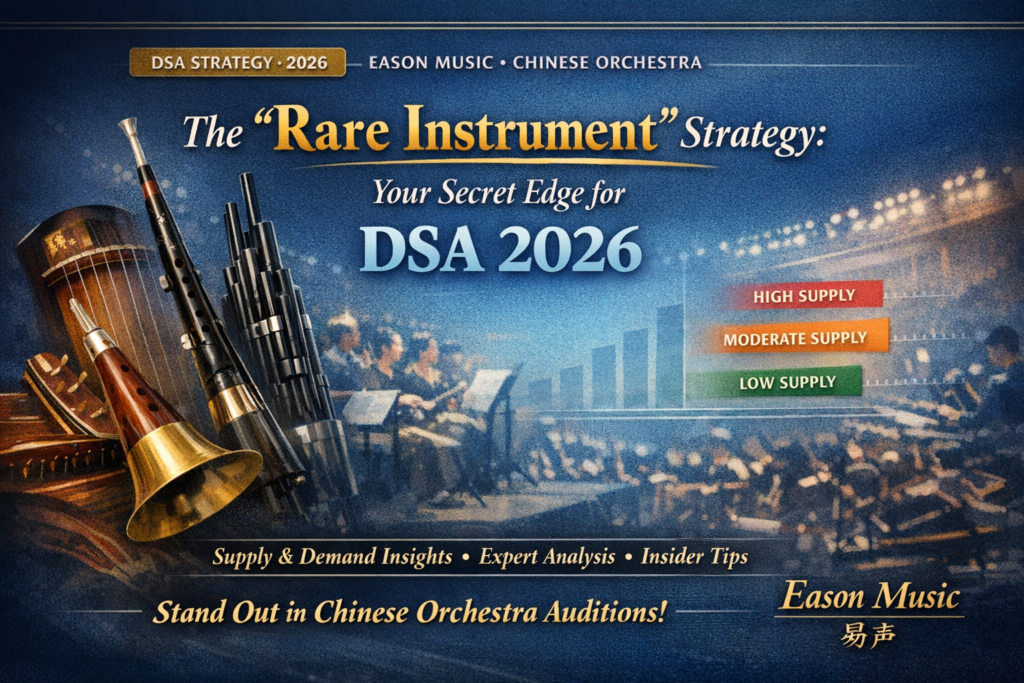
The "Rare Instrument" Strategy:
Your Secret Edge for DSA 2026
As DSA season approaches, parents are asking: "How can my child stand out in a sea of talented musicians?" The answer may lie not in playing better — but in playing smarter.
The Orchestra "Puzzle": Why Supply and Demand Matters
Think of a school Chinese Orchestra like a workplace hiring for specific roles. Every section must be filled for the ensemble to function. If a school receives 20 Guzheng applicants but only one Suona or Sheng player, the conductor faces a very clear problem.
Unless that Guzheng player is absolutely world-class, the school will lean toward the rarer instrument. An orchestra simply cannot perform without its wind section. If your child plays what the school is desperately missing, they aren't just an applicant — they are the missing piece of the puzzle.
Is It Too Late to Switch at Primary 5?
A strategy some parents consider is a "Strategic Pivot" — switching a child from a crowded instrument like the Erhu to a rarer one like the Zhongyin Sheng in Primary 5, purely to improve DSA odds.
This is a high-risk move. Reaching a competitive level on any instrument typically takes at least two years of intensive, passionate practice. By P5, your child is already under significant academic pressure. A rushed switch rarely produces the convincing performance that auditions require.
If your child is currently average at their instrument, the same time and effort invested in truly mastering their original instrument is almost always more effective. A polished, soulful performance on a common instrument often beats a nervous, underprepared audition on a rare one.
The Rare Instrument Strategy works best when it is a genuine passion, not a calculated last-minute switch. Conductors can tell the difference.
Potential vs. Grade: The "Match-Up" Logic
When a conductor sits at the audition table, they are not simply ranking candidates by examination grade. They are evaluating Utility — how does this student fill a need in the orchestra right now, and what can they become?
A Grade 8 Pipa player is an immediately deployable asset. They can lead a section, handle complex repertoire from day one, and require minimal development. At this level, sheer technical excellence outweighs rarity.
Here the calculus shifts. The school likely already has five Grade 5–7 Pipa players, but zero Suona players. A Grade 3 Suona student who demonstrates natural lung capacity, strong rhythm, and genuine enthusiasm represents exactly what the orchestra cannot find elsewhere. Potential + Rarity can beat a middle-grade popular instrument.
The "critical vacancy" changes year by year — it depends entirely on which students are graduating and which sections are depleted. Our instructors, who are active in the CO scene, can give you a realistic read on which schools are likely to be short in which sections for 2026.
The "Aura of Musicality": Does a Second Instrument Help?
Yes — significantly. A student who plays a Western instrument carries what we call an "Aura of Musicality" into the audition room. It signals to judges that this child has strong fundamental musicianship: good rhythm, a trained ear, and a high capacity for growth.
This "aura" is a genuine differentiator. It tells the panel that your child is not a single-instrument specialist — they are a musician who can adapt to the orchestra's evolving needs.
The Strategy Is an Insight, Not a Shortcut
Master your chosen craft. A convincing, polished performance on any instrument will always be the foundation of a successful DSA audition.
Conductors are experienced musicians. They can tell within the first 30 seconds whether a student truly loves the instrument they are playing. That love is irreplaceable.
Strong school results keep all options open. DSA is one pathway — not the only one. A well-rounded student is always in the strongest position.
Get a Realistic Roadmap for DSA 2026
Our instructors — many of whom are active in the CO scene — can evaluate your child's current level and give you an honest assessment of their options for the 2026/2027 DSA exercise.